
AI Vision for the Inspection of Sterile Single-Use Devices
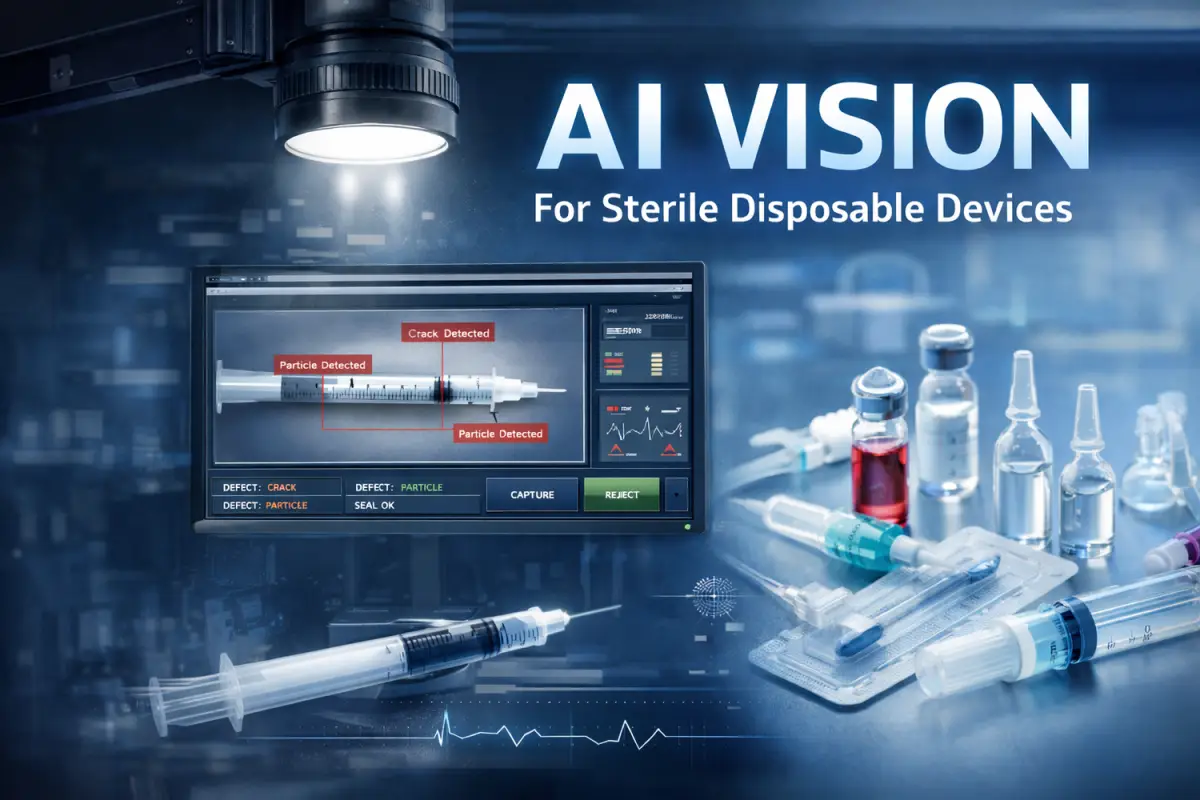
In the medical and pharmaceutical industry, sterile single-use devices represent one of the highest-responsibility product categories: syringes, infusion sets, catheters, dialysis components, surgical kits, and molded plastic medical parts.
Here, quality is not just a regulatory requirement.
It is directly linked to patient safety.
A seemingly minor defect can result in:
-
patient risk
-
GMP non-compliance
-
batch recalls
-
production stoppages
-
reputational damage
In this context, AI Vision applied to automated inspection is rapidly becoming an advanced operational standard.
Inspection Challenges in Sterile Disposable Devices
Sterile single-use devices present several inspection complexities:
-
transparent or semi-transparent materials
-
micro-assembled components
-
thermal or ultrasonic welds
-
blister or pouch sterile packaging
-
labeling and lot code requirements
Common defects include:
-
micro-cracks or deformations
-
molding imperfections
-
visible particles or contaminants
-
incomplete seals
-
incorrect assembly
-
labeling errors
Many of these defects are difficult to detect through manual inspection, especially on high-speed production lines.
Why Manual Inspection Is No Longer Sufficient
Traditional visual inspection has structural limitations:
-
operator fatigue
-
subjective judgment
-
variability between shifts
-
difficulty detecting micro-defects
-
impracticality of 100% inspection at high volumes
In sterile environments, human intervention also represents a potential contamination risk.
Transitioning to automated inspection significantly reduces these structural risks.
How AI Vision Works in Sterile Device Inspection
An AI Vision system integrates:
-
high-resolution industrial cameras
-
controlled lighting (diffuse, backlight, dark-field)
-
deep learning algorithms for defect detection
-
automatic reject mechanisms
-
data storage for traceability
The typical inspection process includes:
-
Image acquisition of the device or packaging
-
Analysis using AI models trained on real defect datasets
-
Classification (compliant / non-compliant)
-
Image and metadata archiving
-
Automatic rejection of defective units
All within milliseconds, directly in-line.
Packaging and Seal Integrity Inspection
For sterile single-use devices, packaging integrity is as critical as the product itself.
AI Vision enables verification of:
-
seal continuity in blisters or pouches
-
presence of micro-channels
-
packaging deformations
-
correct device positioning inside the package
-
lot number and expiration date readability
This is essential for GMP compliance and regulatory audits.
Traceability and Regulatory Compliance
One of the major advantages of AI Vision is the generation of objective digital evidence.
Each inspected unit can be associated with:
-
inspection image
-
timestamp
-
batch ID
-
production parameters
-
shift/operator information
In the event of an audit or customer complaint, manufacturers can demonstrate that inspection was properly executed.
Quality control moves from documented to demonstrable.
ROI for Medical SMEs
For many medical device SMEs, the key question is:
“Is it economically sustainable?”
Today’s AI Vision solutions are:
-
modular
-
integrable into existing production lines
-
scalable
-
typically delivering payback within 12–24 months
Concrete benefits include:
-
scrap reduction
-
fewer customer complaints
-
lower recall risk
-
reduced human intervention in sterile areas
-
stabilized quality performance
The real cost is not implementing AI.
It is failing to detect the defect in time.
From Reactive Inspection to Predictive Quality
By analyzing collected inspection data, manufacturers can:
-
identify recurring defect patterns
-
correlate anomalies with machine parameters
-
intervene before a non-conforming batch is produced
-
continuously improve production processes
Inspection is no longer just a filter.
It becomes a continuous improvement tool.
Conclusion
In the sterile single-use device industry, quality is directly tied to patient safety and manufacturer reputation.
AI Vision enables:
-
100% in-line inspection
-
reduced human variability
-
enhanced traceability
-
stronger compliance
-
recall prevention
The question today is no longer whether to automate inspection.
👉 Is your production line truly capable of detecting every defect before the device reaches the patient?
Contact us at info@metalya.it