
Computer Vision for Detecting Runs and Surface Imperfections
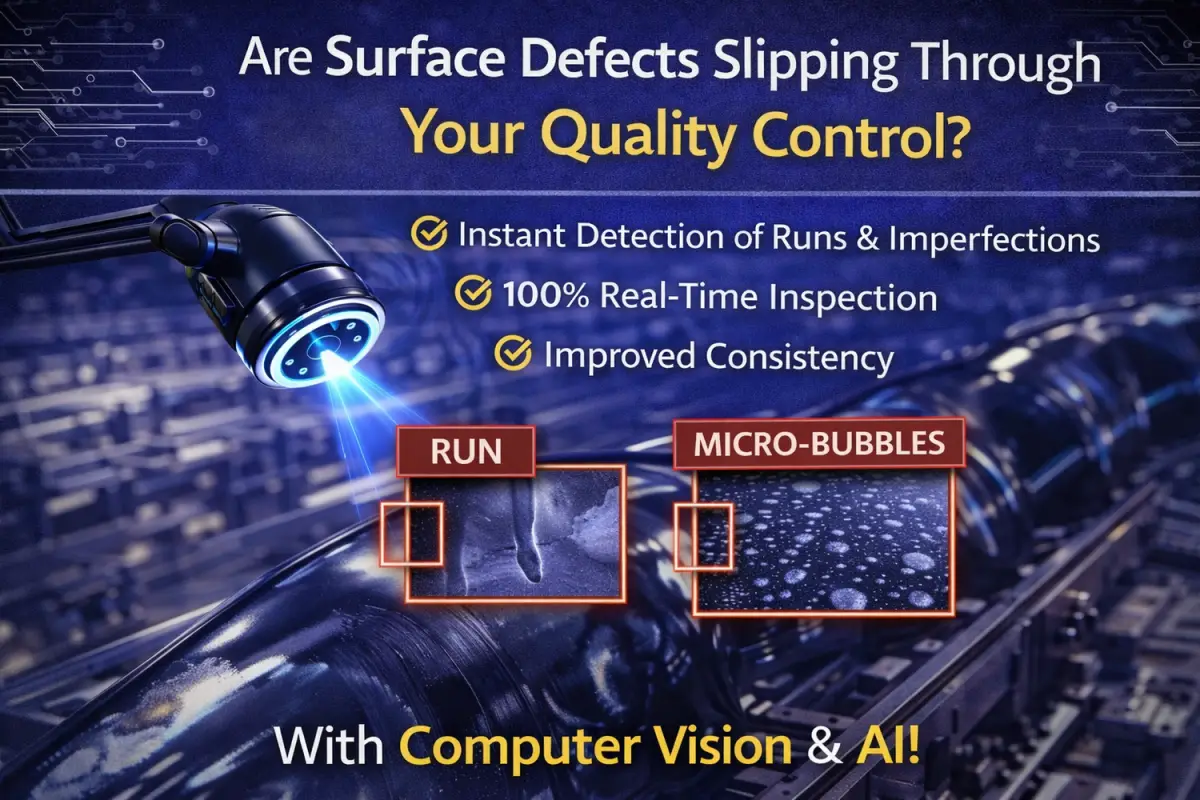
In industrial manufacturing, runs and surface imperfections are common yet critical defects, especially in sectors where aesthetics and functional quality are essential, such as automotive, packaging, electronics, and ceramics.
These defects, often caused by process issues, materials, or environmental conditions, can compromise both the appearance and, in some cases, the performance of the product. Today, thanks to Computer Vision and Artificial Intelligence, it is possible to detect them automatically and in real time, significantly improving quality control.
What Are Runs and Surface Imperfections?
Runs occur when a liquid material (paint, glaze, coating) does not spread evenly across a surface, creating accumulations or irregular flows.
Surface imperfections include a wide range of defects, such as:
-
material buildup
-
droplets or streaks
-
surface non-uniformity
-
micro-bubbles
-
contamination
-
finishing defects
These issues may result from:
-
incorrect material application
-
uncontrolled viscosity
-
environmental conditions (temperature, humidity)
-
equipment-related problems
Why Early Detection Matters
Detecting runs and imperfections at later stages of production leads to higher costs.
Key risks include:
-
finished product scrap
-
costly rework
-
production delays
-
reduced perceived quality
-
customer complaints
Early detection allows manufacturers to act quickly and correct the process.
Limitations of Traditional Inspection
Manual inspection has several limitations:
-
operator subjectivity
-
difficulty detecting subtle defects
-
visual fatigue
-
lack of continuous inspection
In high-speed production lines, these limitations make it difficult to maintain consistent quality standards.
How Computer Vision Works
Computer Vision systems automatically analyze surfaces to detect defects.
1️⃣ Image Acquisition
High-resolution cameras capture images of products along the production line.
Lighting is designed to highlight:
-
reflections
-
textures
-
surface variations
2️⃣ Image Analysis
Algorithms analyze images to detect anomalies.
The system can identify:
-
runs and material accumulation
-
streaks
-
finishing defects
-
texture variations
With AI and Deep Learning, even complex defects can be recognized.
3️⃣ Defect Classification
Defects are classified based on:
-
type
-
size
-
position
-
severity
This enables more effective quality management.
4️⃣ Automatic Action
The system can:
-
reject non-compliant products
-
trigger alerts
-
record data for analysis
-
provide feedback to the production process
Benefits of Computer Vision
Implementing machine vision offers several advantages.
✔ 100% Production Inspection
Every product is inspected in real time.
✔ Higher Precision
Detection of defects difficult to identify manually.
✔ Reduced Scrap
Early identification of anomalies.
✔ Process Improvement
Data analysis helps optimize production parameters.
✔ Consistent Quality
Elimination of operator variability.
Industrial Applications
Inspection of runs and imperfections is critical in various industries:
-
industrial painting
-
coatings and surface treatments
-
ceramics
-
automotive
-
packaging
-
electronics
In all these sectors, surface quality is a key factor.
The Future: Intelligent Surface Inspection
With the evolution of AI and Computer Vision, systems will become increasingly advanced.
Manufacturers will be able to:
-
predict defects before they occur
-
correlate anomalies with process parameters
-
integrate inspection with MES systems
-
automatically optimize production
Conclusion
Runs and surface imperfections represent a major challenge in industrial quality control.
Computer Vision provides an effective solution by automating inspection and ensuring fast, accurate, and continuous quality checks.
In a competitive environment, investing in machine vision technologies means improving quality, reducing costs, and increasing production efficiency.
Want to know more? Contact us at info@metalya.it