
Computer Vision for Inspection of Insulation and Composite Building Materials
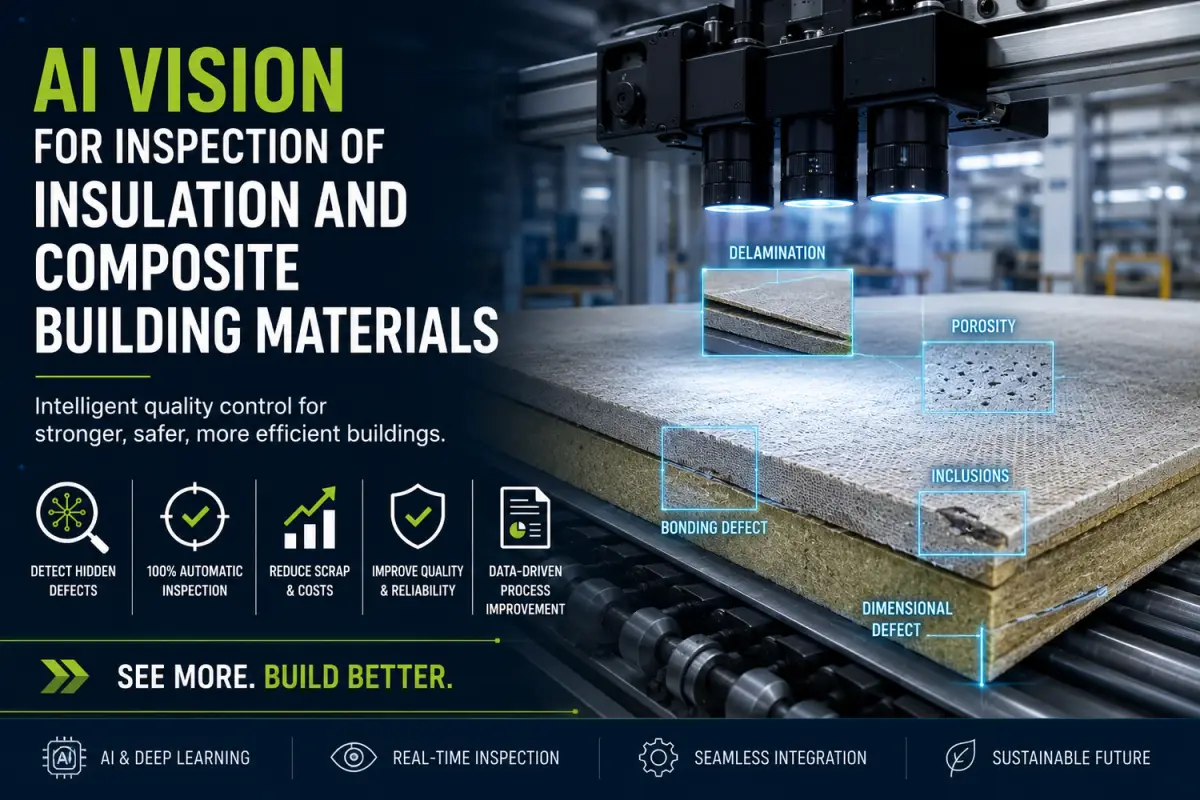
In modern construction, insulation materials and building composites are increasingly used to improve energy efficiency, structural strength, and sustainability. Insulation panels, sandwich materials, fiber-reinforced composites, and advanced cladding systems all require extremely high quality standards.
Even small defects can compromise thermal performance, mechanical strength, and long-term durability. For this reason, AI Vision, which combines Computer Vision and Artificial Intelligence, is becoming a key technology for automating quality inspection of these materials.
The Role of Insulation and Composites in Construction
Insulation and composite materials serve essential functions:
-
thermal insulation
-
acoustic insulation
-
structural reinforcement
-
moisture protection
-
reduction of structural weight
They are widely used in:
-
residential construction
-
industrial prefabrication
-
infrastructure projects
-
ventilated façades
-
advanced structural panels
Their quality directly impacts safety and energy efficiency.
Common Defects in Materials
Several anomalies may occur during manufacturing and processing.
The most common include:
-
delamination
-
voids and porosity
-
micro-cracks
-
bonding defects
-
inclusions or contamination
-
surface irregularities
-
dimensional defects
Many of these issues are difficult to detect manually.
Limitations of Traditional Inspection
Traditional methods include:
-
manual visual inspections
-
sample-based checks
-
destructive or semi-destructive testing
These approaches present several limitations:
-
operator subjectivity
-
difficulty detecting internal defects
-
long inspection times
-
high operational costs
-
lack of continuous inspection
How AI Vision Works
AI Vision systems use industrial cameras and advanced algorithms to analyze materials in real time.
1️⃣ Image Acquisition
High-resolution cameras capture images of material surfaces and structures.
They can be integrated with:
-
thermal imaging
-
3D scanning
-
multispectral vision
2️⃣ Intelligent Analysis
Deep Learning algorithms analyze images to detect anomalies.
The system can identify:
-
surface defects
-
delamination
-
structural variations
-
porosity
-
assembly defects
3️⃣ Defect Classification
Anomalies are classified based on:
-
type
-
severity
-
location
-
size
This enables more effective quality management.
4️⃣ Automatic Action
The system can:
-
reject non-compliant products
-
trigger alerts
-
record data for analysis
-
provide feedback to the production process
Benefits of AI Vision
Implementing machine vision offers several advantages.
✔ Higher Precision
Detection of defects invisible to the human eye.
✔ Continuous Inspection
Automated real-time inspection.
✔ Reduced Scrap
Early identification of anomalies.
✔ Process Improvement
Data analysis helps optimize production.
✔ Increased Reliability
Consistent material quality.
Industrial Applications
AI Vision for inspection of insulation and composites is used in:
-
insulation panels
-
sandwich materials
-
prefabricated building components
-
fiber-reinforced composites
-
façade systems
In all these applications, quality is essential.
The Future: Intelligent Materials and Predictive Inspection
With the evolution of AI, systems will become increasingly advanced.
Manufacturers will be able to:
-
predict defects before they occur
-
monitor materials throughout their lifecycle
-
integrate digital twins and MES systems
-
automatically optimize production processes
Conclusion
In modern construction, quality control of insulation and composite materials is essential to ensure safety, efficiency, and durability.
AI Vision enables automated inspection with fast, accurate, and continuous quality control, improving material reliability while reducing costs and defects.
In a market increasingly focused on sustainability and quality, investing in advanced machine vision technologies represents a strategic choice for the future of construction.
Want to know more? Contact us at info@metalya.it