
Defect Detection in Drywall and Panels with Computer Vision
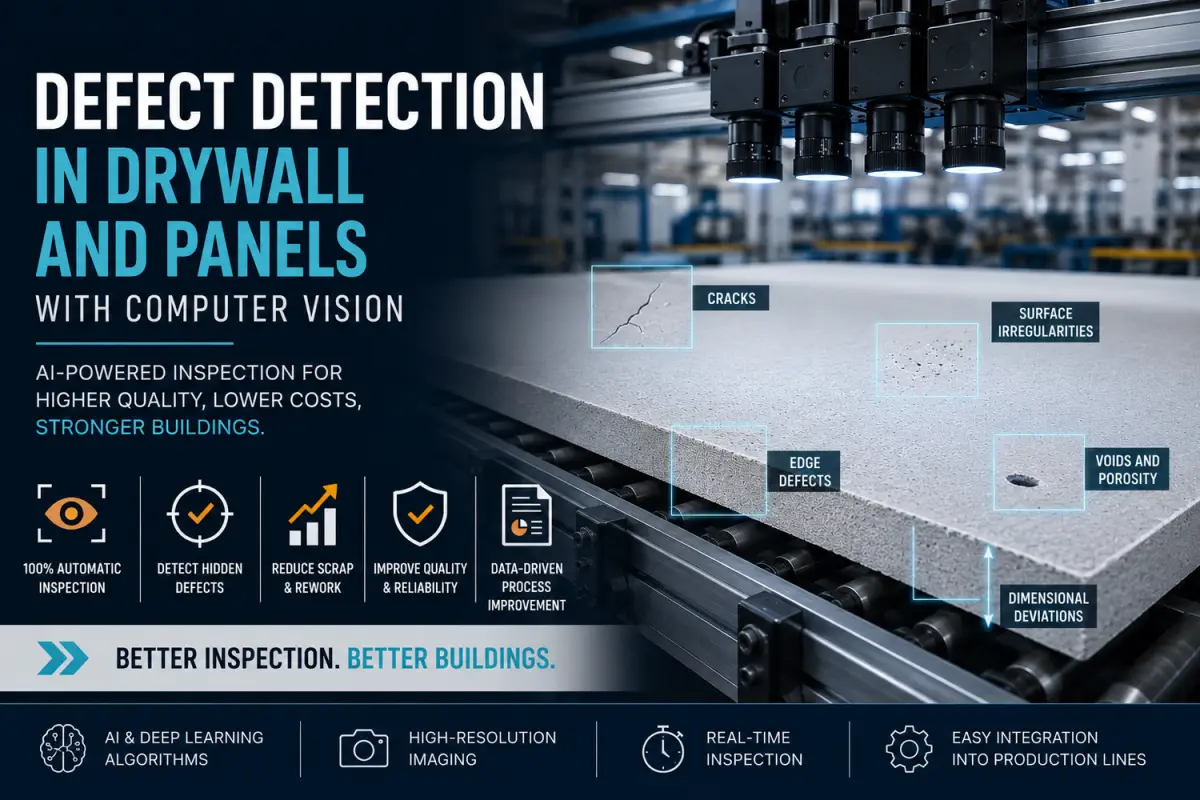
In modern construction, drywall and prefabricated panels are widely used thanks to their versatility, lightweight structure, and fast installation. However, the quality of these products is essential to ensure structural strength, installation accuracy, and aesthetic finish.
During production, defects may occur that are difficult to detect manually, especially on high-speed production lines. For this reason, Computer Vision powered by AI is becoming a strategic technology for automating quality inspection of drywall and panels.
Why Quality Inspection Is Essential
Panels must comply with high standards in terms of:
-
flatness
-
dimensional consistency
-
structural integrity
-
surface quality
-
edge precision
Undetected defects can lead to:
-
installation problems
-
reduced mechanical strength
-
scrap and rework
-
aesthetic defects
-
customer complaints
For this reason, continuous production inspection is critical.
Common Defects in Drywall and Panels
Several anomalies may occur during the manufacturing process.
The most common include:
-
cracks and micro-fractures
-
deformations
-
edge defects
-
voids and porosity
-
surface irregularities
-
contamination
-
dimensional defects
Many of these issues are difficult to detect with manual inspection methods.
Limitations of Traditional Inspection
Traditional methods include:
-
manual visual inspections
-
sample-based checks
-
offline verification
These approaches present several limitations:
-
operator subjectivity
-
visual fatigue
-
inability to inspect 100% of production
-
long inspection times
-
risk of errors
In modern high-productivity facilities, these limitations become critical.
How Computer Vision Works
Computer Vision systems automate quality inspection directly along the production line.
1️⃣ Image Acquisition
High-resolution industrial cameras capture images of panels and surfaces.
Lighting is designed to highlight:
-
textures
-
deformations
-
edges
-
micro-defects
-
dimensional variations
2️⃣ Intelligent Analysis
Deep Learning algorithms analyze images to detect anomalies.
The system can identify:
-
cracks
-
porosity
-
surface defects
-
edge irregularities
-
dimensional deformations
Thanks to AI, the system can also recognize complex or variable defects.
3️⃣ Defect Classification
Defects are classified based on:
-
type
-
severity
-
location
-
size
This enables more accurate quality management.
4️⃣ Automatic Action
The system can:
-
reject non-compliant products
-
trigger alerts
-
record data for analysis
-
provide feedback to the production process
Benefits of Computer Vision
Implementing machine vision offers several advantages.
✔ 100% Production Inspection
Every panel is inspected in real time.
✔ Higher Precision
Detection of defects invisible to the human eye.
✔ Reduced Scrap
Early identification of anomalies.
✔ Process Improvement
Data analysis helps optimize production.
✔ Consistent Quality
Elimination of operator variability.
Industrial Applications
Computer Vision for drywall and panels is used in:
-
drywall panels
-
insulation panels
-
prefabricated building components
-
sandwich panels
-
industrial cladding systems
In all these applications, quality and reliability are essential.
The Future: Intelligent Inspection of Building Materials
With the evolution of AI, systems will become increasingly advanced.
Manufacturers will be able to:
-
predict defects before they occur
-
correlate anomalies with production parameters
-
integrate digital twins and MES systems
-
automate process optimization
Conclusion
In modern construction, quality inspection of drywall and panels is essential to ensure safety, precision, and durability.
Computer Vision enables automated inspection with fast, accurate, and continuous quality control, improving product quality while reducing costs and defects.
Investing in advanced machine vision technologies means increasing production efficiency and ensuring high standards in an increasingly competitive market.