
High-Precision Inspection of Aerospace Fasteners with Computer Vision
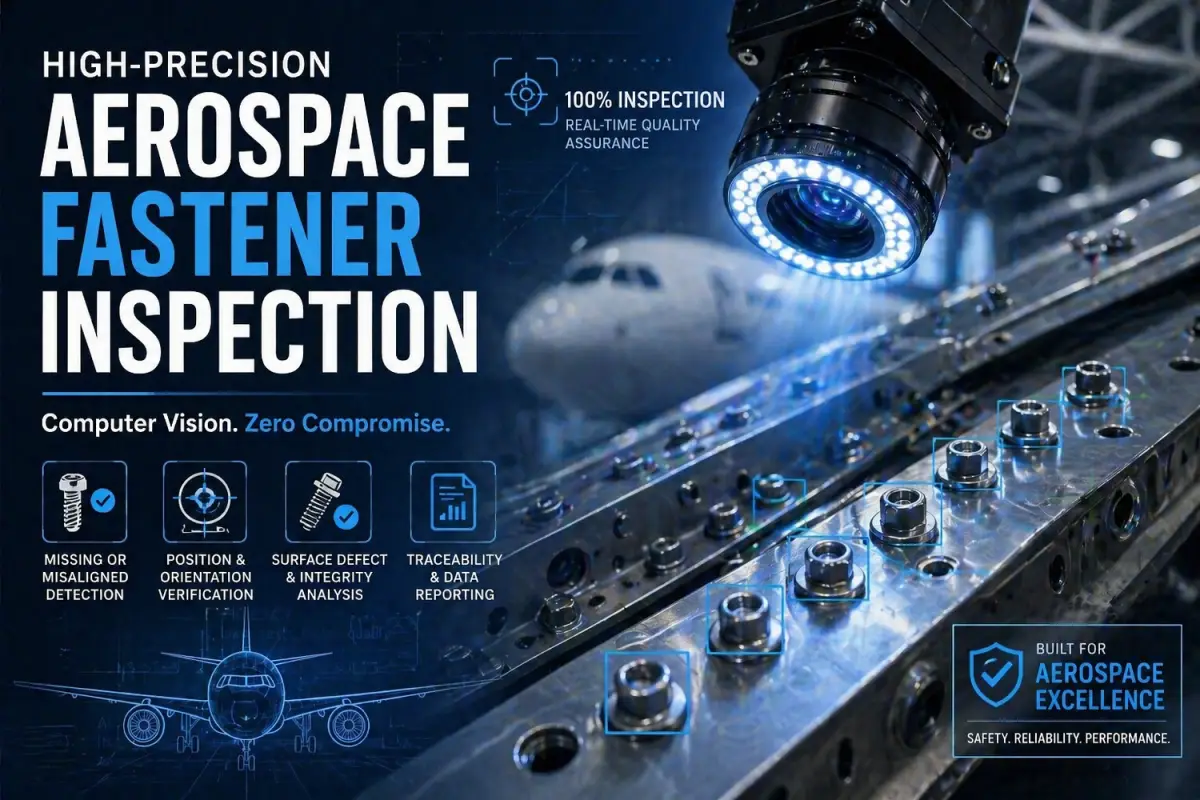
In the aerospace industry, safety often depends on seemingly small details. Among these, aerospace fasteners—such as bolts, rivets, and screws—play a fundamental role in ensuring the structural integrity of aircraft.
A missing, misaligned, or defective fastener can compromise entire structures. For this reason, quality control of these components requires absolute precision, repeatability, and traceability. Today, thanks to Computer Vision and Artificial Intelligence, this process can be automated, achieving unprecedented levels of reliability.
The Critical Role of Aerospace Fasteners
Fasteners are essential elements used to connect and stabilize different parts of an aircraft.
They are found in:
-
fuselage
-
wings
-
internal structures
-
engine components
-
secondary systems
They must withstand:
-
vibrations
-
temperature variations
-
high mechanical stress
Even a single error can lead to critical consequences in terms of safety and performance.
Common Defects in Fasteners
During manufacturing and assembly, several anomalies may occur.
The most common include:
-
missing fasteners
-
incorrect installation
-
wrong orientation
-
improper tightening
-
surface defects (cracks, corrosion)
-
non-compliant components
These defects can be difficult to detect manually, especially in complex and high-density assemblies.
Limitations of Traditional Inspection Methods
Traditional approaches include:
-
manual visual inspections
-
sample-based checks
-
mechanical verification
These methods have important limitations:
-
operator subjectivity
-
visual fatigue
-
difficulty handling large volumes
-
risk of errors
-
long inspection times
In aerospace, where tolerance for error is zero, these limitations represent a significant risk.
How Computer Vision Works
Computer Vision systems enable automated, high-precision inspection.
1️⃣ Image Acquisition
High-resolution industrial cameras are installed along assembly lines.
Lighting is designed to highlight:
-
geometries
-
metallic surfaces
-
defects
-
installation details
2️⃣ Image Analysis
Algorithms analyze images to verify:
-
presence of the fastener
-
correct positioning
-
orientation
-
surface integrity
With AI and Deep Learning, the system can detect even complex anomalies.
3️⃣ Compliance Verification
Each fastener is compared against reference parameters.
The system can identify:
-
missing fasteners
-
assembly errors
-
dimensional defects
-
surface anomalies
4️⃣ Automatic Action
In case of non-conformities, the system can:
-
trigger immediate alerts
-
stop the process
-
record the defect
-
initiate corrective actions
Benefits of Computer Vision
Implementing machine vision offers several advantages.
✔ 100% Production Inspection
Every fastener is verified.
✔ High Precision
Detection of even microscopic defects.
✔ Reduced Errors
Elimination of human variability.
✔ Increased Safety
Lower risk of critical failures.
✔ Full Traceability
Monitoring and recording of every component.
Applications in Aerospace
Automated fastener inspection is used in:
-
aerospace assembly lines
-
component manufacturing
-
maintenance, repair, and overhaul (MRO)
-
in-line quality control
In all these stages, precision and reliability are essential.
The Future: Intelligent Assembly
With the evolution of AI, systems will become increasingly advanced.
Manufacturers will be able to:
-
guide operators during assembly
-
integrate machine vision with robotics
-
correlate defects with process parameters
-
enable predictive maintenance
Conclusion
In aerospace, even the smallest fastener can make a critical difference.
Computer Vision enables automated inspection with extremely high levels of precision, reliability, and traceability, ensuring safety for every component.
In an industry where failure is not an option, investing in advanced technologies means improving quality, reducing risks, and ensuring excellence across the entire production chain.